
At Bir Hospital and the National Trauma Center, medical equipment worth over 1 billion rupees lies broken and unutilized. While hospital administrations ignore the maintenance of these devices, they are found to be purchasing millions of rupees worth of new equipment every year.
In the new seven-story building of Kathmandu’s Bir Hospital, there is a ramp designed to roll wheelchairs and beds up and down. This ramp, intended for wheelchair users, people who struggle with stairs and hospital trolleys, is never open. 
Peering through the locked glass doors on each floor reveals that the ramp is packed with medical equipment and other materials. “Since we had no space to keep the broken hospital equipment, we were forced to store them on the ramp,” admits Dr. Bikash Nepal, Director of Bir Hospital.
Some of the equipment dumped on the ramp could be operated with minor repairs but the hospital has shown no interest in fixing them. Bir Hospital is not alone in leaving broken medical equipment unaddressed. Much like the ramp at Bir Hospital, corridors, rooftops and open spaces at the Trauma Center are used to dump broken equipment. The Auditor General’s report also states, “During on-site inspections of the hospital, equipment was seen kept unsafely in corridors, rooftops and open spaces.”
At these two hospitals under the National Academy of Medical Sciences, medical equipment valued at over 1 billion rupees lies broken and abandoned. While ignoring maintenance, the hospital administrations continue to purchase new equipment worth tens of millions of rupees every year.
According to details obtained through the Right to Information (RTI) by the Nepal Investigative Multimedia Journalism Network (NIMJN), 249 pieces of equipment at Bir Hospital and 153 pieces at the Trauma Center are lying broken. NIMJN received this information from the Ministry of Health and Food Safety at the end of the last fiscal year (mid-July). To determine the current value of the listed equipment, NIMJN sought assistance from three biomedical engineers working in different hospitals. Based on the average value provided by these three biomedical engineers, the total value of the unutilized equipment across both hospitals comes out to over Rs. 1.069 billion. Of this, the equipment at the Trauma Center alone is valued at Rs. 565.08 million, while Bir Hospital’s equipment is valued at Rs. 504.575 million.
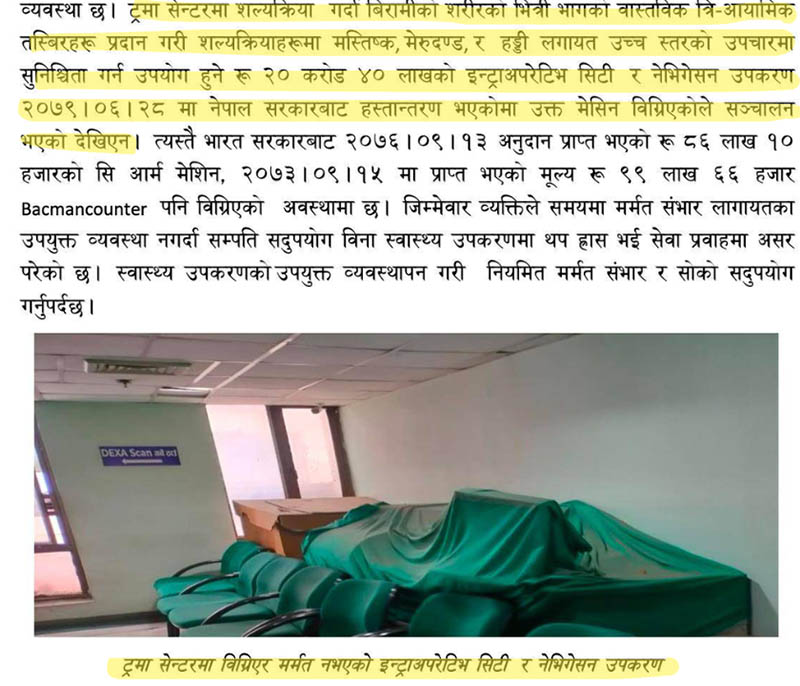
The 31-page list of 693 pieces of equipment at the Trauma Center includes details on 550 operational units and 153 broken ones. Included in this list is an intraoperative CT scanner.
Transferred to the National Academy of Medical Sciences on October 14, 2022, under a Nepal government grant, this Rs. 204 million machine and navigation system broke down less than four years after installation. The Auditor General’s report also notes regarding this machine, “Since the said machine is broken, it was not seen in operation.”
According to doctors, this machine performs CT scans during ongoing surgeries. It displays the internal structures of patients undergoing surgical procedures. This equipment is essential for high-level surgeries involving the brain, spine and bones.
Machines provided as grants by the Government of India, including ventilators worth Rs. 25.132 million, C-arm machines valued at Rs. 8.61 million and a Beckman Coulter cell counter worth Rs. 10 million received on December 30, 2016, are also lying broken and unutilized.
Rule 99, Sub-rule 4(1) of the Financial Procedures and Fiscal Responsibility Rules, 2020 mandates that assets and inventory items requiring repair must be maintained within three months.
At the Trauma Center, there is even a piece of equipment sitting broken that the hospital lacks the personnel to operate and which the hospital has never put to use: a Cath Lab machine. “Equipment for cardiac treatment is simply not needed at the Trauma Center,” said Dr. Rudra Prasad Marasini, Director of the Center. “We have the machine but we don’t have the approved staff positions for it.”
Due to remaining completely unused, the equipment has now developed battery issues. Although the Cath Lab machine, utilizing Digital Subtraction Angiography technology to diagnose vascular diseases and deliver safe, reliable treatment, was received as a grant, it could not be operated due to a shortage of workforce. “The Trauma Center has failed to bring multi-million-rupee equipment into operation,” states the Auditor General’s preliminary report. “These items should be brought into use, otherwise, alternative arrangements must be made.”
Rule 99, Sub-rule 5 of the Financial Procedures and Fiscal Responsibility Rules, 2020 specifies that if property is not in use by an office, a report may be submitted to the parent department and upon receiving instructions, the equipment may be transferred to another government office.
Dr. Rudra stated that while correspondence had been sent to the ministry regarding the transfer of this equipment, no institution showed interest in taking it. “It costs Rs. 40 to 50 million to operate. That is why other hospitals haven’t wanted to take it either,” he said.
Trauma Center Director Dr. Rudra mentioned that items that cannot be repaired and are not in use have to be stored in whatever empty space is available. He added that even after issuing notices three times with valuation and cost estimates to auction off the old equipment, no one submitted a tender application. “We will remove the auctioned equipment before Tihar,” he said.
Meanwhile, Bir Hospital Director Dr. Bikash stated that as he has just taken charge, bringing the ramp into operation remains his immediate priority.
Equipment fails to function due to simple battery issues
The list of Trauma Center equipment obtained by NIMJN from the Ministry of Health notes that several devices are lying unutilized simply due to issues with batteries and circuit boards. Among the unutilized equipment, 28 units are ventilators alone.
Director Dr. Rudra explained that ventilators purchased and received as grants during the coronavirus pandemic broke down because they went unused. “We could not keep patients on ventilators if they did not need them. Because they were not put to use, they deteriorated,” he said.
Other broken equipment on the list includes 24 patient monitors, 12 anesthesia machines, nine ECG machines, 12 syringe and infusion pumps, six C-arm machines, six USG machines, two X-ray machines and one fluoroscopy machine, along with various laboratory and surgical devices. Computerized tomography (CT) scanners, lithotripsy machines used for crushing kidney stones, ultrasound machines and endoscopy units are also broken.
Trauma Center Director Dr. Rudra claims that they prepare an annual list of repairable equipment and fix them regularly. “It is not true that we lack interest in maintenance. In fact, when the CT scanner broke down, we imported parts from India and repaired it within 15 days,” he said.
Much like the Trauma Center, Bir Hospital also has a lengthy list of broken equipment. A total of 26 ventilators are out of service. Additionally, 38 patient monitors, seven hemodialysis machines, and lithotripsy units lie broken and unutilized. The details specify that ventilators are non-functional due to damaged oxygen sensors, failed leak tests and faulty touchscreens requiring replacement, while syringe infusion pumps have failed due to broken plunger drives, power supply boards and other defective components.
Lack of cooperation from vendors is another reason
The records obtained by NIMJN state that several devices in the laboratories and operating theaters could not be repaired due to a lack of cooperation from vendor companies. At Bir Hospital alone, 40 pieces of equipment remain unrepaired because vendors have failed to render support.
These include lithotripsy machines, C-arm units used in operating theaters and outpatient departments, mammography machines for breast cancer screening and diagnosis, endoscopy video processors used to view real-time video during abdominal and digestive system procedures, and EMG machines used for nerve and muscle examinations.
Similarly, urodynamic analyzers that check urinary system and bladder pressure/capacity, blood gas analyzers used to monitor oxygen, carbon dioxide and pH levels in critically ill ICU and OT patients, and electrosurgical unit cautery machines used to seal blood vessels during surgical incisions are all lying idle, awaiting vendor intervention. “High-value machines have remained unutilized for long periods due to the lack of Annual Maintenance Contracts (AMCs) after warranty expiration and the non-availability of required spare parts on time,” the Auditor General’s report confirms.
Public procurement expert Suresh Pradhan noted that medical equipment can only be maintained regularly if purchase contracts mandate maintenance obligations on the seller. “Currently, the problem arises because such clauses are omitted from procurement systems, failing to hold vendor companies and suppliers accountable,” he said.
Bir Hospital Director Dr. Bikash stated that vendor cooperation is crucial for sourcing the spare parts needed to fix many broken devices. He explained that since proprietary parts from the original manufacturer are required, negotiations are ongoing with vendors to secure these components at lower rates. “We have already prepared a list of equipment that needs immediate repair,” he said. “If we fail to fix these machines, services suffer and revenue declines. Therefore, our top priority is repairing existing equipment rather than purchasing new ones.”
Maintenance neglected, irregular purchases continue
While failing to repair broken equipment, the Trauma Center directly procured equipment worth Rs. 43 million and Bir Hospital spent Rs. 22.6 million in the last fiscal year without competitive bidding. The Auditor General has flagged these transactions as irregularities, highlighting how hospitals bypass legal procurement processes to buy new equipment while leaving old machinery abandoned across their facilities.
The Auditor General criticized the hospitals for purchasing critical health equipment, including Tomotherapy machines, ventilators, dialysis machines and modular OT setups, without preparing a comprehensive master plan.
“The procurement process appears to have been initiated without ensuring in advance the availability of installation space, actual operational need, electrical infrastructure or specialized technical personnel to operate the machines,” the Auditor General’s report states. “Because approved procurement/master plans were lacking, and essential terms, such as the useful lifespan of health equipment and post-warranty annual maintenance agreements, were omitted from planning, machines become unusable at the slightest technical glitch.”
Over the past three years, Bir Hospital issued 103 tenders to acquire equipment and medical supplies without preparing a procurement plan or master plan. The Auditor General’s report highlights that the hospital even struggles to maintain updated records of the equipment purchased.
“We have advised them to make service delivery effective by carrying out timely maintenance on available health equipment and ensuring the management of necessary human resources,” said Shreekumar Rai, spokesperson for the Office of the Auditor General.
Both the Auditor General’s report and procurement experts conclude that neglecting maintenance while eagerly pursuing new purchases is driven not by technical issues but by commissions and personal financial gains tied to new procurements. “Procuring directly without open competition is not considered lawful,” said public procurement expert Suresh Pradhan. “Furthermore, drafting specifications tailored to purchase from only a single company constitutes clear irregularity.”
Audits have raised sharp questions over these practices, pointing out that the failure to repair equipment stems from corruption and procurement kickbacks rather than technical limitations or budget shortages. “When purchases that should go through competitive bidding are broken down into smaller pieces to avoid open competition, there is ample room to suspect financial irregularities,” added procurement expert Suresh. The Trauma Center went as far as procuring implants worth Rs. 17.035 million directly, without any competitive bidding.
According to the Auditor General’s Report 2026, the management of the Trauma Center unlawfully procured medical equipment worth Rs. 26.015 million in the Fiscal Year 2024/25. Section 8 of the Public Procurement Act, 2007 stipulates that procurements must not be conducted in a manner that restricts competition.
Similarly, Rule 85(4) of the Public Procurement Rules, 2007 requires public entities to invite written quotations or proposals from at least three suppliers when directly procuring goods valued at over Rs. 100,000.
Even when making direct purchases, the rules specify that procurements from a single supplier must not exceed the prescribed limit in a single fiscal year. However, violating these provisions, the Trauma Center procured goods worth Rs. 25 million without competitive bidding last year.
It made dual purchases from Arwa Nepal Pvt. Ltd., Palpasa Enterprises, Aarogya Meditech Pvt. Ltd. and Divyam Concern. The Trauma Center purchased air conditioners from Palpasa Enterprises, however, proprietor Rajesh Acharya stated that Trauma Center staff merely used his firm’s invoices.
“I trade in medical equipment. A close friend of mine handles AC installation work and he used my firm’s bill. Beyond that, I know nothing about the procurement,” he said. “The invoice must have been issued because my firm was selected after submitting three quotations.” We also contacted Rajesh’s friend, Tirtha Bahadur Karki, who stated that as technicians who only handle AC installations, they were unaware of the procurement process.
From Arwa Nepal Pvt. Ltd., the Trauma Center initially purchased surgical supplies worth Rs. 964,000, followed by a second direct purchase of Rs. 214,000, procuring a total of Rs. 1.178 million in supplies without competitive bidding.
Similarly, it purchased identical items from Aarogya Meditech Pvt. Ltd. for Rs. 972,000 the first time and for the same amount of Rs. 972,000 the second time.
Two separate purchases were also made from Divyam Concern. Anju Manandhar, proprietor of Divyam Concern, stated that her firm supplied the goods after being selected from three submitted quotations. “I sold goods on two occasions,” she said. “Completing the legal procedures is the hospital’s responsibility, not ours.”
Trauma Center Director Dr. Rudra maintains that direct procurement remains the only option when supplies purchased through annual tenders fall short and urgent needs arise. However, he refused to take responsibility for past procurements that failed to comply with rules and procedures. “Whichever official made the purchase is responsible for it,” Dr. Rudra said.
Experts suspect that direct procurements open the door to corruption. “Direct procurement by circumventing the law is unacceptable. Either the law must be amended or compliance is mandatory, simply claiming an urgent need is not enough,” said public procurement expert Suresh Pradhan. “Direct procurement creates significant scope for collusion and collusion is a common occurrence in Nepal.”
Office of the Auditor General spokesperson Shreekumar Rai stated that because direct purchasing violates the law, they consistently advise institutions to conduct competitive procurements. “Hospitals often argue that direct procurement is unavoidable because emergency supplies are required unpredictably at any time, leaving them with no choice but to pay whatever bills are submitted,” Rai said. “However, direct procurement inevitably hides vested interests.”
Even quality checks are not conducted
It has also been revealed that goods procured by Bir Hospital were not even subjected to quality testing. Equipment worth Rs. 64.705 million purchased in the previous year was accepted without any inspection or quality verification.
Noting that the technical specifications and quality of the procured items remain ambiguous, the Auditor General’s report states, “Therefore, to ensure that the supplied goods conform to the prescribed technical specifications and quality standards, inspection and testing by technical experts appear necessary.”
Bir Hospital Director Dr. Bikash stated that since quality service cannot be provided without quality equipment, he remains attentive to this matter. “There may be procedural flaws but we will not allow any compromise on the quality of the equipment,” he said.
Contract with one party, purchase from another
Bir Hospital invited bids for surgical supplies and entered into an agreement with Kasmikar Enterprises, New Baneshwor. Condition No. 2 of the contract states, “If additional supplies beyond the quantities specified in the Bill of Quantities are required, the supplier must supply them at the same rate until April 12, 2025, unless the hospital makes alternative bidding arrangements.”
Accordingly, when procuring additional surgical items, the hospital was required to purchase them at the contracted rate from the firm selected through the bidding process. However, instead of buying from Kasmikar Enterprises, the hospital subsequently purchased surgical gloves from Bluestar Surgical House at an inflated price, paying an extra Rs. 22.24 per pair. “When purchasing surgical gloves from Bluestar Surgical House on January 9, 2025, through open quotation calls, the hospital paid Rs. 22.24 per pair more than the rate agreed upon with Kasmikar,” the Auditor General’s report notes. The report explicitly highlights an irregularity of Rs. 556,000 in this glove procurement alone.
Dr. Samir Kumar Adhikari, Joint Spokesperson for the Ministry of Health, stated that repairing and auctioning broken hospital equipment remains the sole responsibility of the respective hospital administration. “The ministry’s role is strictly limited to managing the necessary budget allocation. Procurement, maintenance and auction processes fall entirely under the hospital’s domain,” he said.
However, he noted that the ministry does take an interest when procurements violate rules and procedures. “If rules and standard procedures are breached during procurement, maintenance or auction processes, it certainly draws the ministry’s attention,” he said.
Procurement without competition
Bir Hospital was found to have procured goods worth Rs. 19.383 million without open competition. In these procurement instances, only a single bid was submitted, which was subsequently approved.
Last year, among the tenders invited following cost estimation approvals and technical specifications set by the technical committee, contracts were awarded to suppliers who were the sole bidders.
In six other tenders where multiple proposals were submitted, the technical evaluation disqualified all but a single supplier, leaving only one qualified bidder. Various suppliers had even filed applications with Bir Hospital requesting amendments to the technical specifications prepared by the committee for five of these tenders.
In its report, the Office of the Auditor General notes, “This indicates that procurement specifications were tailored around specific brands, thereby narrowing the scope of competition. Consequently, there is no ground to be confident that the procurements were conducted in a competitive environment as required by the Procurement Rules. The administration must focus on expanding competition in procurements to ensure goods are supplied at competitive rates.”
The Auditor General raised serious concerns over limited competition regarding two contracts awarded to Garg Dental, Contract No. 2081/82/62 worth Rs. 2.376 million and Contract No. 2081/82/55 worth Rs. 2.788 million.
Under Contract No. 2081/82/55, which covered 74 types of dental and oral care items, the technical committee flagged certain delivered items as ‘non-compliant’ in its report. Despite this, the hospital released full payment. The Auditor General has ordered the recovery of Rs. 63,473 from Garg Dental.
However, Umesh Agrawal, proprietor of Garg Dental, maintained that the supplies were delivered after completing all formal procedures. “If procedures had not been fulfilled, my company would not have been selected in the first place,” he said, adding that the hospital has neither raised complaints regarding non-compliance nor requested any monetary recovery.
Bir Hospital was also found to have directly purchased a floor scrubber machine for Rs. 980,840 from Dynamic Medical System. Ramendra Neupane, proprietor of Dynamic Medical System, claimed the hospital followed due process. “Procurement without competition is simply not possible,” he said. “We submitted our quotation to Bir Hospital, our rates were the lowest, and that is why they bought from us.”
Office of the Auditor General spokesperson Shreekumar noted that hospital administrators often complain that purchasing medical equipment under existing procurement acts and rules is impractical. “We consistently tell them that if the law is impractical, submit a proposal through the Ministry of Health to amend it. But splitting procurements into smaller batches to evade open tenders against the law is wrong,” he said. “There is a clear intention to bypass procurement planning and buy exclusively from a limited group of preferred suppliers.”
Please adhere to our republishing policy if you'd like to republish this story. You can find the guidelines here.


Comments